> For the complete documentation index, see [llms.txt](https://support.whapi.cloud/help-desk/llms.txt). Markdown versions of documentation pages are available by appending `.md` to page URLs; this page is available as [Markdown](https://support.whapi.cloud/help-desk/tools/whatsapp-activity-safety-meter.md).
# WhatsApp Activity Safety Meter
This indicator allows you to calculate the risk level for activity on your number
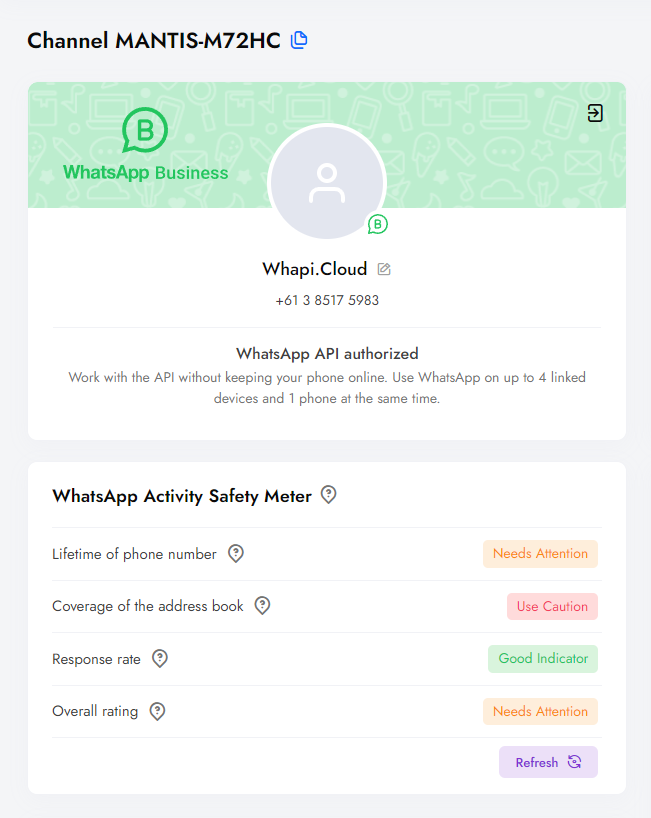
*This functionality is only available on a paid plan.* The metric is located on the channel page in your dashboard.
If your number doesn't show significant activity, it's worth introducing this activity gradually. [To warm up the number](/help-desk/blocking/warming-up-new-phone-numbers-for-whatsapp-api.md), we recommend paying attention to these important metrics (*Instructions for launching:* [Automatic warm-up module](/help-desk/tools/automatic-warm-up-module.md))
{% hint style="info" %}
You can only update your scores once a day!
{% endhint %}
### Metrics
* **Lifetime of phone number**: Older numbers have the opportunity to be more active with less risk. Recently registered numbers are more closely monitored by WhatsApp. If you are planning mass activity, you should first take care of warming up the number;
* **Coverage of the address book**: WhatsApp flags activity by interacting with unfamiliar contacts. Engage with your target audience and encourage your clients to add you to their contacts;
* **Response rate**: A higher response rate indicates a healthy engagement with your audience. A low response rate may signal to WhatsApp that your activity looks like spam;
The metric is located on the channel page in your dashboard
{% hint style="info" %}
For more details on how to enhance your WhatsApp security and reduce the risk of being blocked, check out our comprehensive guide on using residential proxies [here](/help-desk/blocking/using-residential-proxies-with-whapi.cloud.md).
{% endhint %}
### Get data via API
#### Calculate metric
{% hint style="success" %}
**POST**
{% endhint %}
The request will require specifying a **Header** with the name **Authorization** and the value "**Bearer {channel\_token}**"
Calculates all metrics connected to the channel number.
You can recalculate and get new metrics data only once a day. If you have already received data today, the endpoint will not recalculate the data, but will return the saved data.
```json
{
"channel": "{channel_token}",
"lastUpdateDate": "5/20/2024",
"lifeTime": 1, // Lifetime of phone number
"riskFactor": 2, // Overall rating
"riskFactorChats": 3, // Response rate
"riskFactorContacts": 2 // Coverage of the address book
}
```
#### What the values mean
* 3: "Good Indicator",
* 2: "Needs Attention",
* 1: "Use Caution"
***
#### Get the value
{% hint style="success" %}
**GET**
{% endhint %}
The request will require specifying a **Header** with the name **Authorization** and the value "**Bearer {channel\_token}**"
Returns the metric's performance if it was previously calculated
---
# Agent Instructions
This documentation is published with GitBook. GitBook is the documentation platform designed so that both humans and AI agents can read, navigate, and reason over technical content effectively. Learn more at gitbook.com.
## Querying This Documentation
If you need additional information that is not directly available in this page, you can query the documentation by asking a question.
Perform an HTTP GET request on the following URL with the `ask` and `goal` query parameters:
```
GET https://support.whapi.cloud/help-desk/tools/whatsapp-activity-safety-meter.md?ask=&goal=
```
`ask` is the immediate question: it should be specific, self-contained, and written in natural language.
`goal` is what the user is ultimately trying to achieve, the reason they need the answer. Sharing it helps GitBook give you a better, more relevant answer. A goal is most helpful when it describes the outcome the user wants rather than restating the question. For example, with `ask=how do I create an API token`, a goal like `automate deployments from our CI pipeline` lets GitBook tailor the answer to that use case.
The response will contain a direct answer to the question and relevant excerpts and sources from the documentation.
Use this mechanism when the answer is not explicitly present in the current page, you need clarification or additional context, or you want to retrieve related documentation sections.